
Uber's California Ballot Initiative Threatens Accident Victims' Access to Lawyers and Medical Care
By Adam Kocaj · April 29, 2026
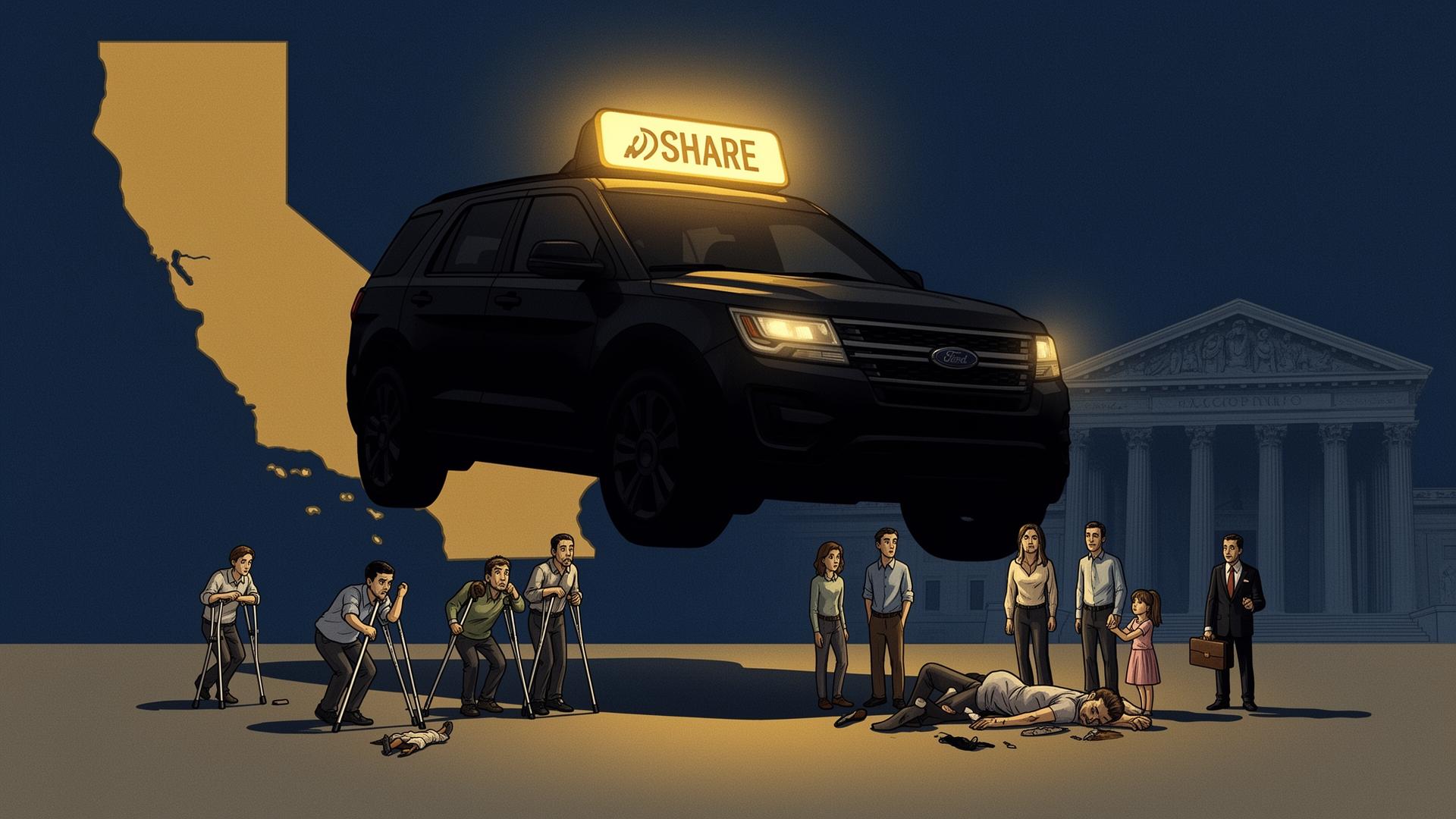
Uber is backing a California ballot initiative with a friendly-sounding message: protect accident victims from greedy lawyers and inflated medical bills.
But voters should look past the slogan.
The official California title tells a different story. The Attorney General titled the measure: "Limits Automobile Accident Victims'' Recovery of Medical Expenses and Fees Their Attorneys May Receive." According to the Secretary of State, the measure would limit what injury attorneys can be paid, increase the burden of proof for certain medical expenses, and limit the medical damages accident victims may recover. It does not limit what defendants, insurance companies, or corporations can spend on their lawyers.
That is the part voters need to understand.
This is not just a measure about "bad lawyers." It is a proposed constitutional amendment that could make it harder for injured Californians to get legal help, obtain medical treatment, and recover the full cost of care after a car crash.
What the Uber-backed initiative would do
The proposal would apply to motor-vehicle accident cases. In plain English, it would do three major things.
First, it would limit contingency-fee arrangements in auto accident cases so the injured person keeps at least 75% of the recovery after certain costs are deducted. That may sound good at first. But serious injury cases are expensive to bring. Lawyers often advance the costs of experts, depositions, medical records, accident reconstruction, and trial preparation. If the case is risky or expensive, some attorneys may simply stop taking those cases.
Second, the measure would limit what accident victims can recover for medical expenses. For some unpaid medical bills and future medical care, recovery could be tied to Medicare, Medi-Cal, or other benchmark rates instead of the actual cost of treatment. The Legislative Analyst explains that the measure would limit medical damages in motor-vehicle cases and increase the burden of proof for medical liens.
Third, it would ban certain financial arrangements between lawyers and medical providers. Preventing kickbacks and improper referral schemes is a legitimate goal. But this initiative goes much further than targeting fraud. It rewrites the rules for ordinary accident victims too.
Why most crash victims need a contingency-fee lawyer
Most people injured in a crash cannot pay a lawyer by the hour. They also cannot afford to pay thousands of dollars up front to build a case against an insurance company or corporation.
That is why contingency fees exist. The lawyer takes the risk. The client pays only if there is a recovery.
The state''s fiscal analysis says the measure would likely reduce court costs partly because attorneys would decline some cases they otherwise would have pursued.
That should concern everyone.
When a lawyer declines a legitimate case because the economics no longer work, the injured person does not become more protected. The injured person becomes more alone.
Meanwhile, Uber, insurance companies, and other defendants can still pay their lawyers whatever they want.
The medical-treatment problem
After a crash, medical care cannot wait for a lawsuit to end.
Some accident victims are uninsured. Some are underinsured. Some cannot get the specialists they need through their health plan. Some doctors treat patients on a lien, meaning the provider agrees to wait for payment until the case resolves.
The Legislative Analyst explains that medical liens are one way injured people receive treatment without immediate payment. But under this measure, medical-lien claims would face a higher burden of proof, and the amount recoverable for some medical care would be limited.
That could make doctors less willing to treat accident victims on liens.
The result could be simple and harsh: fewer lawyers willing to take difficult cases, fewer doctors willing to treat injured patients, and less accountability for the companies and insurers defending those cases.
Taxpayers could also pay more
The state''s analysis found that the measure could increase Medi-Cal costs by millions to tens of millions of dollars each year. Why? Because if fewer injured people recover compensation, Medi-Cal may recover less money from cases where it paid for crash-related care.
So the measure may reduce costs for defendants and insurers while shifting more costs onto public programs.
That is not consumer protection. That is cost shifting.
Why is Uber spending so much?
Uber is not a neutral bystander. The FPPC lists the supporting committee as "A More Affordable California, Sponsored by Uber," and lists Uber Technologies, Inc. as the top contributor with more than $77.5 million.
Voters should ask: why would Uber spend that much money on a measure affecting auto accident cases across California?
One obvious answer is that Uber has massive exposure to vehicle-related injury claims. If a ballot measure makes injury cases harder to bring, harder to prove, or less valuable, that benefits companies that get sued after crashes.
What about self-driving taxis?
This issue becomes even more important when you consider Uber''s future.
Uber is actively preparing for autonomous rides in California. In April 2026, Uber and MOIA announced that autonomous ID. Buzz vehicles are being tested in Los Angeles, with rides on the Uber platform planned for late 2026. Uber and MOIA also said they plan to scale a fleet of autonomous vehicles, starting in Los Angeles.
The initiative does not specifically say "robotaxis." But it applies broadly to motor-vehicle accident cases. If a self-driving Uber-affiliated vehicle injures a passenger, pedestrian, cyclist, or another driver, this measure could affect the victim''s ability to recover medical damages and hire a lawyer.
So while we cannot say Uber''s only motive is robotaxi liability, the timing matters.
This measure could create a liability-limiting framework before autonomous vehicles become a larger part of Uber''s business in California.
How does Uber's ballot initiative affect my car accident case in California?
If you are reading this in 2026 because you were just hurt in a crash, the short answer is this: nothing has changed yet. Initiative 25-0022 has only entered circulation. It is not law, and it does not apply to any case filed before California voters approve it. Your existing claim is governed by current California law.
If the measure does pass on the November 2026 ballot, future motor-vehicle accident cases would be different in three concrete ways. First, attorney contingency fees in auto-accident cases would be capped so the injured client retains at least 75% of the monetary recovery. Second, the amount you can recover for certain medical expenses (especially unpaid bills and future medical care) would be tied to benchmark rates and would face a higher burden of proof. Third, certain financial arrangements between attorneys and medical providers — including some lien-based treatment models — would be banned outright.
The practical effect is that complex, expensive, or hard-to-prove crash cases become less economically viable for plaintiffs' firms to take. Victims with catastrophic injuries, disputed liability, or limited insurance coverage would feel the change first.
What is the official name of the Uber-backed California ballot initiative?
Two names are circulating, and the difference matters. The proponents — counsel from Nielsen Merksamer, on behalf of "A More Affordable California, Sponsored by Uber" — call it the "Protecting Automobile Accident Victims from Attorney Self-Dealing Act." That is the name on the petition you may see in front of a grocery store.
The official ballot title prepared by California Attorney General Rob Bonta on December 9, 2025, is very different: "Limits Automobile Accident Victims' Recovery of Medical Expenses and Fees Their Attorneys May Receive. Initiative Constitutional Amendment." The Secretary of State's December 10, 2025 release confirms that title and lists the measure as Initiative 25-0022A1. It has not yet been assigned a Proposition number.
When you sign a petition or read voter materials, look for the AG's official title, not the proponents' marketing title.
What is the proposed 25% contingency fee cap, and how is it different from existing California law?
California already regulates contingency fees through Business and Professions Code §6147 (which governs disclosure and reasonableness) and through MICRA limits on medical malpractice fees. Standard contingency fees in auto accident cases run 33⅓% pre-litigation and up to 40% if the case proceeds to trial.
Initiative 25-0022 would write a new rule into the California Constitution: in motor-vehicle accident cases, the injured client must retain at least 75% of any monetary recovery after costs. In other words, the lawyer's fee is capped at roughly 25% of the net recovery. The cap applies only to plaintiffs. Defendants — Uber, insurers, trucking companies, government entities — could still pay their attorneys whatever hourly rate they want, with no constitutional ceiling.
That asymmetry is the point. We explain the mechanics in detail in our companion post on the proposed 25% contingency fee cap.
Will I still be able to hire a personal injury lawyer in California if Initiative 25-0022 passes?
Yes — but the type of case that gets accepted will narrow. Personal injury law in California is not going away. The Bar will not be abolished. Lawyers will still take strong, well-documented motor-vehicle cases with clear liability and serious damages.
What changes is the math at the margins. If a case requires $80,000 in expert witness costs, multiple depositions, and accident reconstruction, and the realistic recovery is $300,000, a 25% net cap leaves a thin margin for the firm to cover risk on cases that lose. Firms will become more selective. Victims with smaller cases, soft-tissue injuries, contested liability, or uncooperative insurers may find it harder to secure representation — even when their claim is legitimate.
We address this directly in our companion piece on hiring a personal injury lawyer if the Uber-backed measure passes.
When would the measure take effect, and does it apply retroactively?
If California voters approve Initiative 25-0022 on the November 3, 2026 general election ballot, it would take effect the day after the election is certified, per the California Constitution. Because it is structured as a constitutional amendment, the Legislature could not water it down without another statewide vote.
The measure as drafted is not retroactive. It would apply prospectively to motor-vehicle accident cases filed after the effective date. Cases filed before that date — including cases pending in court, in arbitration, or in pre-litigation negotiation — would be governed by current California law.
The bottom line
Fraud should be punished. Kickbacks should be banned. Fake medical bills should not be rewarded.
But Californians should not be fooled into supporting a measure that may limit real accident victims'' access to lawyers, medical treatment, and full compensation.
Uber''s campaign may sound like it is protecting victims.
The official title says what it really does: it limits automobile accident victims'' recovery of medical expenses and the fees their attorneys may receive.
Before signing a petition or voting on this measure, Californians should read the fine print.
Because this is not just about lawyers. It is about whether injured people can still stand up to powerful companies, insurance carriers, and, possibly, the next generation of self-driving vehicles on California roads.
Disclaimer: This post is for general information only and is not legal advice. Voters should review the official Secretary of State, Attorney General, and campaign finance materials before signing any petition or voting.
Source story
The Sacramento Bee: Read the original article →
Disclaimer: This commentary is provided for informational purposes only and does not constitute legal advice or commentary on any specific pending case. No attorney-client relationship is formed by reading this content. Past results do not guarantee future outcomes.
Free consultation
If this headline feels personal, talk with Kocaj Law before evidence disappears.
Serious freeway crashes move quickly from emergency response to insurance defense. Our firm can help preserve video, identify every responsible party, and explain your options with no upfront fee.