
Garden Grove Chemical Tank Emergency: What Orange County Residents Need to Know
By Adam Kocaj · May 24, 2026
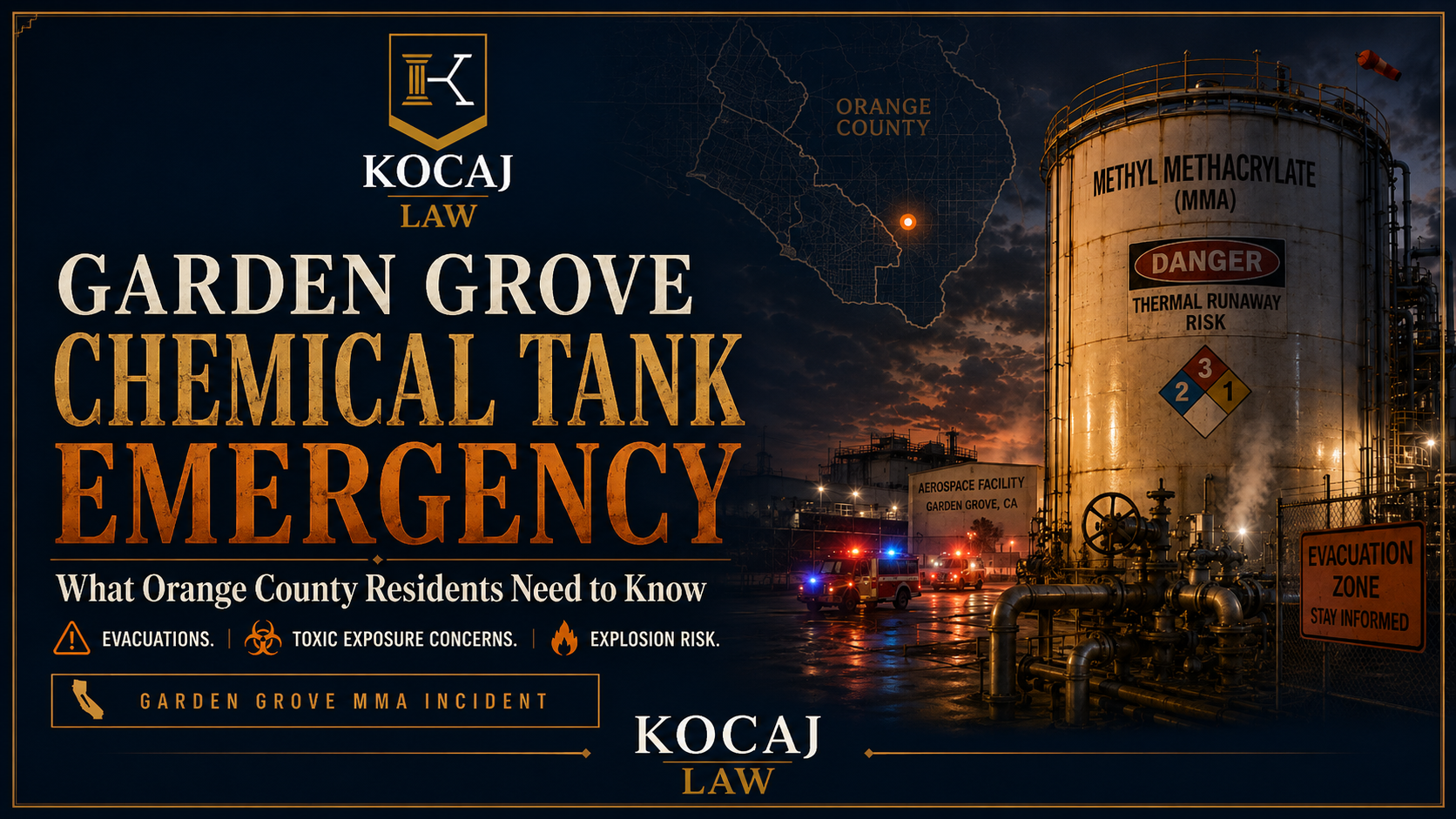
Attorney Advertising.
A major industrial chemical emergency unfolding in Orange County has forced approximately 50,000 residents from their homes and raised serious concerns about public safety, toxic exposure, and the risk of a catastrophic tank explosion.
Authorities are working to stabilize a chemical tank at the GKN Aerospace Transparency Systems facility in Garden Grove containing thousands of gallons of methyl methacrylate, or MMA, a flammable industrial chemical used in acrylic plastics, aircraft canopies, and aerospace manufacturing. As of Memorial Day weekend, mandatory evacuation orders remain in place across portions of Garden Grove, Cypress, Stanton, Anaheim, Buena Park, and Westminster.
Many Orange County residents are asking the same question: how dangerous is this really, and are we looking at another East Palestine?
The short answer is probably not. But that does not mean the legal and financial consequences will be minor, and several things residents should be doing right now could significantly affect their position later.
What Is Methyl Methacrylate?
Methyl methacrylate is a colorless industrial liquid used to manufacture acrylic plastics, resins, and the transparent panels and canopies used in commercial and military aircraft. It has several properties that make this particular incident unusually difficult to resolve. It is highly flammable, with a flashpoint of approximately 50°F. It is heavier than air, meaning vapor settles low and travels along the ground rather than dispersing upward. And it is chemically unstable in a very specific way that matters here.
MMA is a monomer, a single molecule that wants to chain itself together into a polymer (acrylic plastic). It is kept stable in storage by a small amount of chemical inhibitor that only works in the presence of dissolved oxygen. When the liquid heats up, two things happen at once: the oxygen is driven off, and the inhibitor is consumed. Once polymerization begins, it is exothermic, meaning the reaction itself produces more heat, which then accelerates the reaction further. This is what officials and engineers refer to as a thermal runaway.
The Garden Grove tank reached this dangerous state because its cooling system failed, and then its pressure-relief and inlet valves became blocked by chemical hardening, the very polymerization the inhibitor was supposed to prevent. With the valves inoperable, crews have been unable to relieve pressure, introduce additional stabilizer, or transfer the chemical to a safe container. That valve failure is the central technical fact of this incident, and from a legal standpoint, the most important one.
Is This Another East Palestine?
The 2023 East Palestine, Ohio train derailment has appeared in nearly every news cycle covering this story. The two incidents are not equivalent, and there are several material differences.
Volume. East Palestine involved more than 115,000 gallons of vinyl chloride across five tank cars. The Garden Grove tank contains 6,000 to 7,000 gallons of MMA, roughly one-seventeenth the scale.
The chemical itself. Vinyl chloride is a known human carcinogen with serious long-term health implications. MMA's health effects are primarily acute and short-duration: respiratory and eye irritation, headaches, nausea, skin irritation, and aggravation of pre-existing conditions like asthma. It does not carry the same long-tail carcinogenic profile that has driven East Palestine litigation.
The response. East Palestine's catastrophic plume was created by the deliberate decision of a small, volunteer fire department to vent and burn the contents of five tank cars in open terrain. Orange County's response is being led by the Orange County Fire Authority, a Type 1 hazmat-trained agency, with manufacturer chemists on site and outside experts being brought in from across the country. No responder is currently proposing to release or burn off the chemical on purpose.
Likely geographic footprint. If this incident escalates, the most likely impact zone remains concentrated around Garden Grove and immediately adjacent areas. This is not shaping up to be a regional or multi-state environmental catastrophe.
That said, it absolutely could become a significant industrial liability event, even in the best-case outcome.
The Three Realistic Outcomes
Based on the chemistry, the response posture, and what officials are now publicly describing, here are the three scenarios in approximate order of likelihood.
Controlled in-tank cure (most likely). Crews are using a sustained exterior water deluge to slow the polymerization enough that the contents harden into a solid acrylic mass inside the vessel before pressure exceeds the tank's structural limits. Orange County Fire Authority Division Chief Craig Covey described this approach on Saturday, comparing it to an ice cube freezing from the outside in. If this works, no chemical is released and the tank itself becomes a complex but contained hazardous-waste removal problem.
Contained liquid spill (second most likely). The tank ruptures and releases its 6,000 to 7,000 gallon contents into the surrounding parking lot. Containment booms have already been deployed to prevent the chemical from reaching storm drains, local creeks, or the Pacific. This would produce significant localized soil and concrete contamination and weeks of remediation, but no broad community health emergency.
Thermal runaway explosion (least likely). The tank fails catastrophically, producing a BLEVE-style event with severe structural damage at the facility, shrapnel risk, a fireball, and a heavier-than-air MMA vapor plume that would settle and drift downwind. Per Orange County Fire Authority's published blast-zone maps, severe structural damage would be confined to within roughly 500 to 1,000 feet of the tank, with moderate damage extending out to perhaps a quarter to half mile. Disneyland, Knott's Berry Farm, and Angel Stadium are all well outside any meaningful blast or vapor-impact zone.
The Decisive Facts to Watch Over the Next 72 Hours
A handful of developments will determine which scenario plays out:
- Internal tank temperature trend. As of Saturday, the interior temperature was reported at 90°F and rising approximately one degree per hour. If that trend stops or reverses, the cure-in-place strategy is working.
- Air monitoring results. Officials should release VOC readings, MMA-specific concentration levels, and updated dispersion modeling. These readings will become critically important in any future litigation.
- Wind direction and weather conditions. Wind patterns determine which neighborhoods and businesses face vapor exposure if a release occurs.
- Whether any combustion event occurs. A contained vapor release is one situation. A fire involving MMA produces additional toxic combustion byproducts and dramatically increases the damage profile.
- Storm drain and runoff testing. Fire suppression efforts use enormous volumes of water. Environmental testing of nearby drainage systems will become important in evaluating downstream contamination claims.
Why This Will Create Significant Legal Exposure Regardless of How It Ends
Even in the best-case outcome, a successful in-tank cure with no release, the legal exposure for GKN Aerospace and any related parties is substantial. The reason is straightforward: this incident did not result from an unforeseeable act of God. It resulted from a cooling-system failure compounded by valves that polymerized shut, which is a documented maintenance and inspection issue.
Several enforcement and legal tracks are already in motion. A class-action lawsuit has been filed on behalf of two evacuees by The X-Law Group, P.C. and Presidio Law Firm, LLP. The Orange County District Attorney has launched a criminal investigation and is publicly soliciting whistleblowers. Governor Newsom's state of emergency declaration unlocks additional state-level investigative and enforcement resources. Cal/OSHA and the U.S. Environmental Protection Agency will almost certainly examine the facility's maintenance records, prior incident history, and safety reporting compliance.
Affected residents and businesses may have viable claims for property damage and diminution of value for homes and commercial property within the evacuation footprint; business interruption losses for restaurants, retail, and other businesses forced to close during the evacuation period; loss of use and out-of-pocket expenses including hotel costs, alternative shelter, meals, lost wages, child care, and pet boarding; personal injury claims for individuals with documented respiratory irritation, eye or skin irritation, or aggravation of pre-existing conditions such as asthma or COPD; and toxic exposure and nuisance claims under California's well-developed body of toxic-tort law.
Class Action vs. Individual Claim, An Important Distinction
The existence of the class-action lawsuit does not foreclose individual claims, and many residents will be better served by representation evaluating their specific situation. Business owners with significant interruption losses, homeowners with substantial property concerns, and individuals with documented health impacts often recover materially more through individual representation than through a class settlement designed to compensate the average class member.
Whether a class action or an individual claim makes more sense depends on the facts of each case. That decision deserves more than a sign-up form.
What to Do Right Now if You Have Been Affected
Whether or not you intend to pursue a claim, the most important step in the next several days is documentation. Industrial incidents often become heavily contested years later. The people who document early consistently place themselves in a stronger legal position.
- Save every evacuation-related receipt, including lodging, meals, fuel, pet boarding, child care, and missed work.
- Photograph the condition of your home or business before and after, and document any property left behind.
- Save all communications from emergency services, your insurer, employer, and any government agency.
- Seek medical evaluation promptly if you experienced any physical symptoms, even mild ones, and ensure those symptoms are recorded in your medical records along with the suspected MMA exposure context.
- Notify your insurance carrier in writing. Most homeowners, renters, and business policies include civil authority or additional living expense coverage that activates during a mandatory evacuation, regardless of whether your property was physically damaged. Many people never file because they assume coverage doesn't apply, and it often does.
Companion Reading
For a faster overview, see our 60-second quick-read summary. Business owners inside the evacuation zone should also review our guide to business interruption and civil authority claims.
Follow This Story on Social Media
We are also covering this incident on Instagram and LinkedIn.
How Kocaj Law, P.C. Can Help
Kocaj Law, P.C. represents individuals and families across Orange County and the rest of Southern California in personal injury, toxic exposure, and property damage matters. If you or your family were evacuated, displaced, or harmed as a result of the Garden Grove chemical incident, we are available to review your situation, explain your legal options, and help you decide whether to pursue an individual claim, join the existing class action, or take a different path.
There is no fee for an initial consultation, and we work on a contingency basis for qualifying matters, meaning you pay nothing unless we recover for you.
Serving clients throughout Orange County, California.
This blog post is provided for general informational purposes and does not constitute legal advice or create an attorney-client relationship. Every situation is fact-specific, and you should consult with a licensed attorney about your particular circumstances. Kocaj Law, P.C. is a California professional corporation serving Orange County and throughout Southern California. Adam Kocaj is licensed to practice law in California and Michigan.
Disclaimer: This commentary is provided for informational purposes only and does not constitute legal advice or commentary on any specific pending case. No attorney-client relationship is formed by reading this content. Past results do not guarantee future outcomes.
Free consultation
If this headline feels personal, talk with Kocaj Law before evidence disappears.
Serious freeway crashes move quickly from emergency response to insurance defense. Our firm can help preserve video, identify every responsible party, and explain your options with no upfront fee.