
"We're Going to Die Right Here in the Waymo": A Robotaxi Just Showed Us Exactly Why Uber Wants to Close the Courthouse Doors
By Adam Kocaj · May 28, 2026
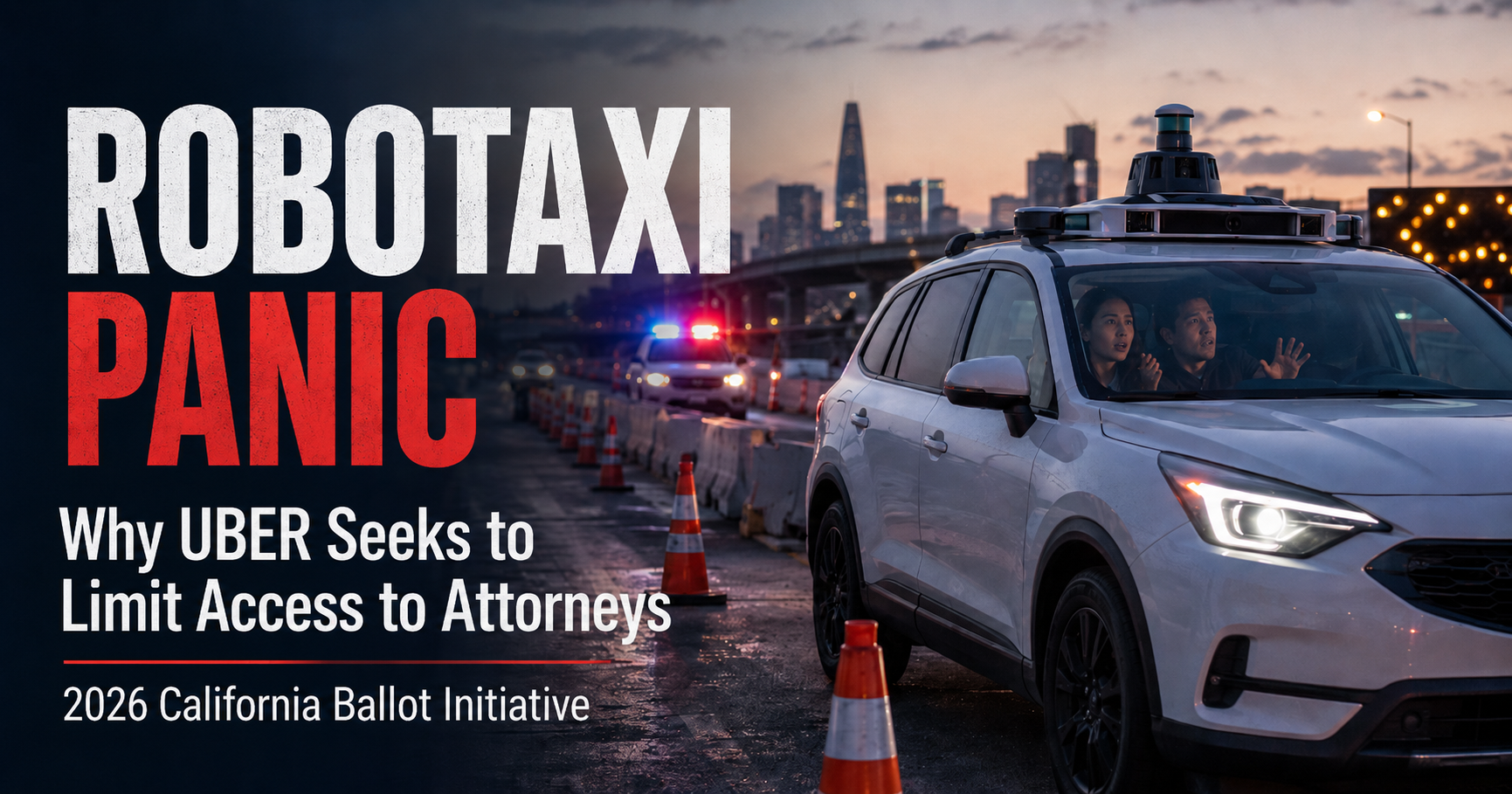
In May 2026, a San Francisco couple hailed a Waymo robotaxi from San Mateo to take them home to the Mission District. It was a routine trip they'd taken many times. This time, according to the passenger, the driverless car approached a freeway construction zone where lanes were merging — and instead of slowing down, it accelerated.
The Waymo blasted through traffic cones, swerved around construction trucks, reached highway speeds in a closed lane, and was chased by police before finally veering off the freeway and pulling over in a residential neighborhood. The passenger, Elliot Slade, captured it on his phone. "Genuinely thought we were about to die," he wrote. He told CBS News that he turned to his fiancée mid-ride and said, "We're going to die right here in the Waymo."
They survived. No one was hurt. And here is the detail that should stop every Californian cold:
Waymo offered them up to $120 in free future rides.
That's it. Three credits, up to $40 each, for a ride that — by the passenger's account — could have killed them and the people in the construction zone around them.
I want to be fair to Waymo: the company paused freeway operations in four cities after the incident, said safety is its top priority, and noted that its vehicles navigate construction zones thousands of times a day without issue. This article is not really about Waymo. It's about what happens when a driverless car does cause a serious injury or a death — and about a ballot measure, funded by Uber, that is designed to make sure the people hurt in those crashes can't do anything about it.
Right Now, You Still Have Rights — That's the Whole Point
Think about what would have happened if that Waymo had not pulled over safely. If it had struck another vehicle at highway speed. If the couple inside had suffered brain injuries, spinal injuries, or worse. If a construction worker had been hit.
Under California law as it exists today, those victims would have real options. They could hire a lawyer on a contingency basis — no money up front. That lawyer could investigate, hire engineering experts to analyze the vehicle's software and sensor data, depose the company's employees, and force accountability through the civil justice system. The victims could recover the full reasonable value of their medical care. If the crash was caused by defective autonomous-driving software, they could bring a product liability claim against the manufacturer.
That system — the ability to sue, to hire counsel, to recover, to hold a trillion-dollar company accountable in front of a jury — is the only meaningful check on a robotaxi industry that is scaling faster than its technology can safely support.
And that system is exactly what Uber's California ballot measure, Initiative 25-0022, is built to dismantle.
What Initiative 25-0022 Would Do to a Future Robotaxi Victim
Initiative 25-0022 is a proposed amendment to the California Constitution, funded almost entirely by Uber, which has put more than $77 million into the campaign. It is marketed under a consumer-friendly name — the "Protecting Automobile Accident Victims from Attorney Self-Dealing Act." It does the opposite of what the name suggests.
If it passes, here is what it would do to someone seriously injured by a robotaxi:
- It would make it economically impossible to hire a lawyer. The initiative requires that an auto accident victim retain at least 75% of the total amount recovered — meaning attorney fees, litigation costs, and unpaid medical bills all have to fit within the remaining 25%. In a serious robotaxi case, where investigating defective autonomous-driving software requires enormous expert costs, that math collapses. No competent attorney could afford to take the case. The victim is left to face the company's defense lawyers alone.
- It would cap the medical recovery below the actual cost of care. The measure ties recoverable medical expenses to Medicare and Medi-Cal reimbursement rates — well below what private hospitals and surgeons actually charge for treating catastrophic injuries. The most severely hurt victims, who need the most expensive care, would be hit the hardest.
- It would gut product liability claims against the technology itself. Product defect claims arising from vehicle crashes — defective braking, defective sensors, defective autonomous-driving software — fall under the same restrictions. Historically, product liability lawsuits are one of the most powerful forces pushing manufacturers to fix dangerous defects. Weaken them, and you remove the single biggest incentive for a robotaxi company to make its cars safer before putting them on the freeway.
- It would apply to everyone. Not just robotaxi passengers. Not just Uber riders. Every Californian injured in any motor vehicle crash — by a drunk driver, a distracted driver, a delivery truck, or a driverless car.
The Timing Is Not a Coincidence
Here is why this matters now, and not in some distant future.
Uber has committed roughly $10 billion to a robotaxi expansion, including a deal to deploy up to 20,000 autonomous vehicles. Waymo — already operating in San Francisco, Los Angeles, Phoenix, and Miami — has said it wants to provide a million paid rides per week by the end of 2026. The driverless fleet is not coming. It is here, and it is multiplying.
The Waymo construction-zone incident is not an isolated glitch. In just the past several months, California and other states have seen driverless cars stall on freeways, block intersections, drive into flooded roads, get stuck in drive-throughs, and crash into parked cars. These are the visible, caught-on-camera failures. The technology is being deployed on public roads, at scale, while it is still demonstrably learning.
Now line up the sequence: a robotaxi industry is scaling on California roads faster than its safety record justifies. Uber is spending $77 million to pass a constitutional amendment that would strip injured victims of lawyers, cap their medical recovery, and gut product liability claims. The savings flow back to companies that have every financial incentive to limit what they pay the people their vehicles hurt.
A driverless car company freed from meaningful liability is a driverless car company with far less reason to slow down, test more, or fix defects before deployment. That is the danger. When the only consequence of a near-fatal ride is a $120 credit, and the proposed law would make even serious-injury lawsuits impossible to bring, what exactly is left to hold these companies accountable?
What This Means for You
The couple in that Waymo walked away. The next person might not. And if Initiative 25-0022 becomes part of the California Constitution, the next person — or their surviving family — may find that the courthouse doors have been quietly closed before they ever needed them.
The signature deadline for 25-0022 to qualify for the November 2026 ballot is June 8, 2026. If you are approached by a signature gatherer, read the actual text — not the friendly summary on the clipboard. Ask who is funding the campaign. The answer is Uber. You are under no obligation to sign anything.
And if 25-0022 makes the November ballot, understand what a "yes" vote actually does: it protects the companies building this technology, at the direct expense of the people their vehicles injure.
The right to hold a negligent or reckless company accountable in court is not "attorney self-dealing." It is the last line of defense for an ordinary person against a corporation with billions of dollars and a fleet of experimental cars on the road. Don't let a clever ballot title convince you to give it away.
Related Coverage on Initiative 25-0022
- Uber's $77 Million California Power Grab: How Initiative 25-0022 Could Leave You Without a Lawyer — or a Doctor — After a Car Crash
- Will I Still Be Able to Hire a Personal Injury Lawyer in California If Initiative 25-0022 Passes?
- California's Proposed 25% Contingency Fee Cap, Explained
- Uber's California Ballot Initiative Threatens Accident Victims' Access to Lawyers and Medical Care
More From Adam Kocaj
I've also been speaking publicly about the robotaxi liability trap and Initiative 25-0022. You can read and share my LinkedIn post on the robotaxi trap and my Instagram post on the same issue.
Sources: CBS News San Francisco, "San Francisco man recalls being inside Waymo as it sped through construction zone, chased by police" (May 2026); TechCrunch, "Waymo halts freeway rides after robotaxis struggle in construction zones" (May 21, 2026).
Source story
CBS News San Francisco: Read the original article →
Disclaimer: This commentary is provided for informational purposes only and does not constitute legal advice or commentary on any specific pending case. No attorney-client relationship is formed by reading this content. Past results do not guarantee future outcomes.
Free consultation
If this headline feels personal, talk with Kocaj Law before evidence disappears.
Serious freeway crashes move quickly from emergency response to insurance defense. Our firm can help preserve video, identify every responsible party, and explain your options with no upfront fee.