
Congress Is Considering a Liability Shield for Uber, Lyft, and Other App-Based Companies
By Adam Kocaj · June 1, 2026
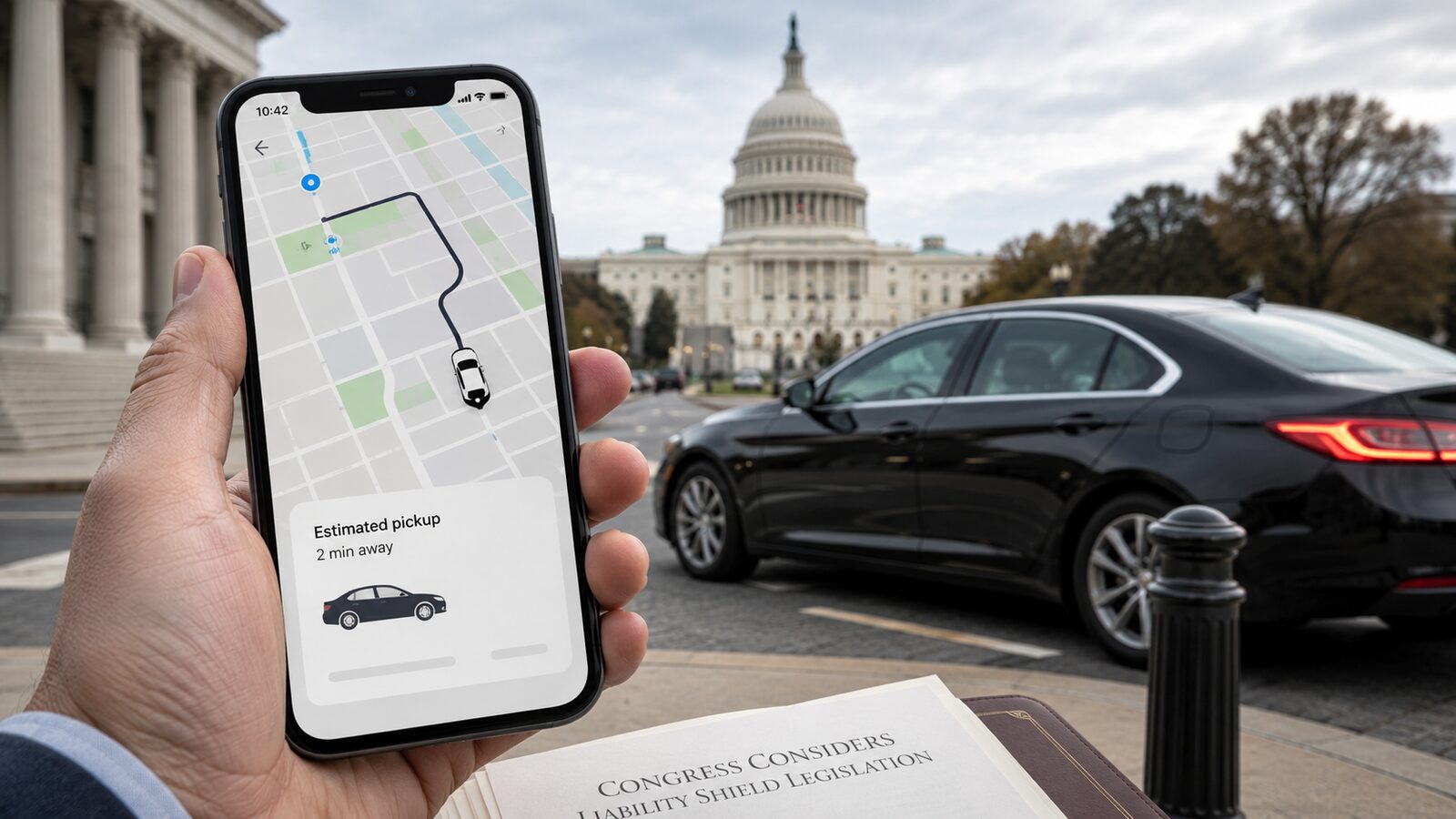
Most people think of an Uber or Lyft ride as transportation. You open an app, a driver accepts the trip, and the company takes a percentage of the fare.
A pending federal amendment would treat that relationship very differently when something goes wrong.
During the House Transportation & Infrastructure Committee markup of the BUILD America 250 Act, H.R. 8870, Rep. Vince Fong of California offered Amendment 041. The amendment passed by a narrow 35–30 recorded vote. That close vote matters. This was not a routine, uncontested transportation provision. It was a disputed liability rule, and it can still be removed before any final bill becomes law.
If enacted, Fong Amendment 041 would add a new federal statute: 49 U.S.C. § 30107, "Vicarious liability for network companies." The amendment would protect app-based "network companies" from many state-law claims involving app-based drivers unless the company was grossly negligent or committed criminal wrongdoing. It specifically targets claims based on common-carrier, non-delegable, or similar duties.
In plain English, the amendment would make many claims against companies like Uber, Lyft, and similar app-based platforms much harder to bring or prove.
The older law Congress is using as a model
To understand the new amendment, it helps to start with a law most people have never heard of: the Graves Amendment.
Congress passed the Graves Amendment in 2005 as part of the federal surface transportation law known as SAFETEA-LU. The Graves Amendment generally says that a rental car company cannot be sued just because it owned the vehicle involved in a crash. So if a person rents a car and causes a collision, the injured person usually cannot hold the rental company responsible based only on ownership of the car.
That rule may sound harsh, but the Graves Amendment kept an important door open. A rental car company can still be held responsible if the company itself was negligent or committed criminal wrongdoing. For example, if a rental company knowingly rents a car to someone who should not be driving, the Graves Amendment does not give the company a free pass.
That distinction matters. The Graves Amendment protects rental companies from automatic owner-based liability. It does not excuse their own carelessness.
Fong Amendment 041 borrows that same federal-liability-shield framework, but changes the key protection.
Why this amendment is different
The Graves Amendment preserves claims based on ordinary negligence. Fong Amendment 041 would require something more: gross negligence or criminal wrongdoing.
For non-lawyers, that difference is huge.
Ordinary negligence means a person or company failed to use reasonable care. In an injury case, that might mean a company missed a warning sign, ignored a safety complaint, used weak screening procedures, or failed to take a reasonable safety step.
Gross negligence is much harder to prove. It usually means conduct that is far more serious than a mistake or poor judgment. Cornell's Legal Information Institute describes gross negligence as a lack of care showing reckless disregard for the safety or lives of others.
So if Congress changes the standard from negligence to gross negligence, that is not a small technical edit. It raises the burden on injured people.
A passenger could show that a company was careless. A passenger could show that the carelessness caused real harm. But under this amendment, ordinary carelessness may not be enough. The passenger may have to prove the company's conduct was reckless or extreme.
That is why this amendment matters.
Why the common-carrier language matters
The amendment also takes aim at claims based on "common carrier," "non-delegable," or similar duties.
Those are legal terms, but the basic idea is simple. Some businesses that transport people owe passengers a heightened duty of safety. A "non-delegable" duty means the company cannot avoid responsibility simply by saying the driver was an independent contractor.
That issue is already being litigated against Uber.
In a North Carolina bellwether case in the federal Uber passenger sexual-assault multidistrict litigation, Judge Charles Breyer granted partial summary judgment on common-carrier status and liability. The court held that Uber "clearly qualifies as a common carrier" under North Carolina law and that Uber owed passengers a non-delegable duty to transport them safely.
That does not mean every Uber case is automatically the same. These issues can depend on the state law involved, the facts of the case, and the final instructions given to a jury. But it does show why the language in Fong Amendment 041 is important. The amendment targets the same kind of legal theory that passengers and assault survivors are already using in court.
Why this is happening now
This amendment comes while Uber is facing major litigation over alleged sexual assaults by drivers.
In February 2026, a federal jury in Arizona ordered Uber to pay $8.5 million in compensatory damages to plaintiff Jaylynn Dean. The jury found the driver was an agent of Uber, holding the company responsible for his actions. The jury did not award punitive damages and rejected other claims, including negligence and design-defect claims.
That case was the first federal bellwether trial among more than 3,000 similar lawsuits consolidated in federal court. Uber also faces more than 500 additional cases in California state court.
In April 2026, a federal jury in North Carolina ordered Uber to pay $5,000 to a woman who claimed she was sexually assaulted by a driver she booked through the app. Reporting described that case as another bellwether trial in the same broader litigation.
The damages award in the North Carolina case was much smaller than the Arizona verdict. But the legal issue was significant because Uber argued it was a software company, not a common carrier with a passenger-safety duty under North Carolina law.
That context is important. Fong Amendment 041 would not merely affect future lawsuits in the abstract. It could affect the very legal tools passengers and assault survivors are using now.
The amendment may reach past conduct
The amendment is not limited to future incidents.
As drafted, it would apply to lawsuits filed after the law takes effect, even if the harm or the conduct that caused the harm happened before the law passed.
That does not necessarily mean it would automatically end cases that have already been filed. But it could affect people who were harmed before the law passed and had not yet filed suit.
That is a serious change. People should not lose important rights through language placed inside a transportation funding bill without public attention and debate.
This is bigger than Uber and Lyft
The amendment does not only refer to rideshare companies. It uses the broader term "network company."
Under the amendment, a "network company" includes a business that operates an online-enabled application or platform connecting customers with app-based drivers for transportation, on-demand delivery, or other facilitated services.
That means the amendment could reach beyond passenger rides. It could also affect claims involving delivery platforms and other app-based driver services.
Supporters describe the amendment as a protection against abusive litigation affecting rideshare companies and insurance coverage. But for injured people, the practical effect could be simple: fewer ways to hold a company responsible when its own safety practices fall short.
What the amendment does not do
The amendment does have limits.
It does not excuse app-based companies from state or local laws dealing with background checks or driver qualifications. It also does not override state financial-responsibility or insurance-standard laws.
It also does not protect a company that was grossly negligent or committed criminal wrongdoing.
But those limits do not solve the main problem. The amendment would still make ordinary negligence claims much harder to pursue against app-based network companies. For many injured people, ordinary negligence is the core claim.
What this could mean for passengers and injury victims
If the amendment becomes law, passengers and injury victims may still have rights. A driver may still be responsible for what the driver did. A company may still face liability if gross negligence or criminal wrongdoing can be proven.
But that is not the same as preserving ordinary negligence claims.
The real concern is that the amendment would make it harder to hold powerful app-based companies responsible for preventable harm caused by weak safety practices, ignored warnings, inadequate screening, or other ordinary carelessness.
This is not about making companies automatically responsible for everything a driver does. The law should not impose automatic liability in every case. The question is whether Congress should give app-based companies a federal shield even when an injured person can show that the company's own negligence contributed to the harm.
That is the line this amendment threatens to move.
This can still be stopped
Fong Amendment 041 has cleared committee, but it is not final law. The House Transportation & Infrastructure Committee ordered H.R. 8870 reported by a 62–2 vote, and the bill still must move through the legislative process. House committee leaders have said they expect further House action and work with the Senate before current surface transportation law expires on September 30, 2026.
The amendment passed by only five votes. That close margin matters.
If you are concerned about this amendment, contact your U.S. Representative and both U.S. Senators. Ask them to remove Fong Amendment 041, proposed 49 U.S.C. § 30107, from the BUILD America 250 Act.
A simple message is enough:
Please remove Fong Amendment 041 from the BUILD America 250 Act. Uber, Lyft, and other app-based transportation companies should not receive a federal liability shield that makes ordinary negligence claims harder for injured passengers and assault survivors to bring.
Most people never hear about amendments like this until after they become law. Public attention matters now.
If you or a loved one has been harmed by a rideshare driver, you still have rights today. At Kocaj Law, P.C., we represent injured Californians against powerful corporations and insurers. Call us at (949) 807-4055 for a free, confidential consultation.
Frequently Asked Questions
What is Fong Amendment 041?
Fong Amendment 041 is a provision added during the House Transportation & Infrastructure Committee markup of the BUILD America 250 Act (H.R. 8870). If enacted, it would create a new federal statute, 49 U.S.C. § 30107, shielding app-based "network companies" like Uber and Lyft from many state-law claims involving app-based drivers unless the company was grossly negligent or committed criminal wrongdoing.
Does the amendment stop me from suing Uber or Lyft after a crash?
No. It would not eliminate your rights, but it would make ordinary negligence claims against app-based companies much harder to bring or prove. You could still pursue the driver, and you could still pursue the company if you can show gross negligence or criminal wrongdoing.
How is this different from the Graves Amendment?
The Graves Amendment of 2005 protects rental car companies from automatic owner-based liability but still allows ordinary negligence claims. Fong Amendment 041 borrows that framework but raises the bar, requiring gross negligence or criminal wrongdoing instead of ordinary negligence.
Would the amendment apply to incidents that already happened?
As drafted, it would apply to lawsuits filed after the law takes effect, even if the harm occurred before the law passed. That means people harmed before the law passed who have not yet filed suit could be affected.
Does the amendment only affect Uber and Lyft?
No. It uses the broader term "network company," which can include delivery platforms and other app-based driver services, not just rideshare passenger trips.
What should I do if I was injured by a rideshare or app-based driver?
You still have rights today. Speak with a licensed attorney promptly so evidence can be preserved. Kocaj Law, P.C. offers free, confidential consultations at (949) 807-4055.
Related from Kocaj Law
- "We're Going to Die Right Here in the Waymo": A Robotaxi Just Showed Us Exactly Why Uber Wants to Close the Courthouse Doors
- Uber's $77 Million California Power Grab: How Initiative 25-0022 Could Leave You Without a Lawyer — or a Doctor — After a Car Crash
- Uber's California Ballot Initiative Threatens Accident Victims' Access to Lawyers and Medical Care
- Will I Still Be Able to Hire a Personal Injury Lawyer in California If Initiative 25-0022 Passes?
- California's Proposed 25% Contingency Fee Cap, Explained
Disclaimer: This article is for general informational purposes only. It is not legal advice and does not create an attorney-client relationship. Laws and pending legislation can change quickly, and the status or text of the bill discussed here may have changed after publication. Past case results discussed in this article are not results obtained by Kocaj Law, P.C., and do not guarantee any particular outcome. If you have a specific legal question, speak with a licensed attorney. This communication may be considered attorney advertising.
Disclaimer: This commentary is provided for informational purposes only and does not constitute legal advice or commentary on any specific pending case. No attorney-client relationship is formed by reading this content. Past results do not guarantee future outcomes.
Free consultation
If this headline feels personal, talk with Kocaj Law before evidence disappears.
Serious freeway crashes move quickly from emergency response to insurance defense. Our firm can help preserve video, identify every responsible party, and explain your options with no upfront fee.